Meet Your Hosts

The two people you'll actually be playing with.

Tomoaki has spent his working life in fashion retail and around tennis, and kept meeting visitors who wanted to play in Tokyo and gave up — the booking is awkward if you don't read Japanese, and courts in the city are usually full. Stuart came over from Hawaii and has been collecting trophies from half the towns in western Tokyo ever since. Between us we thought we could make it easy: take people out to the greener courts in the suburbs, and play.

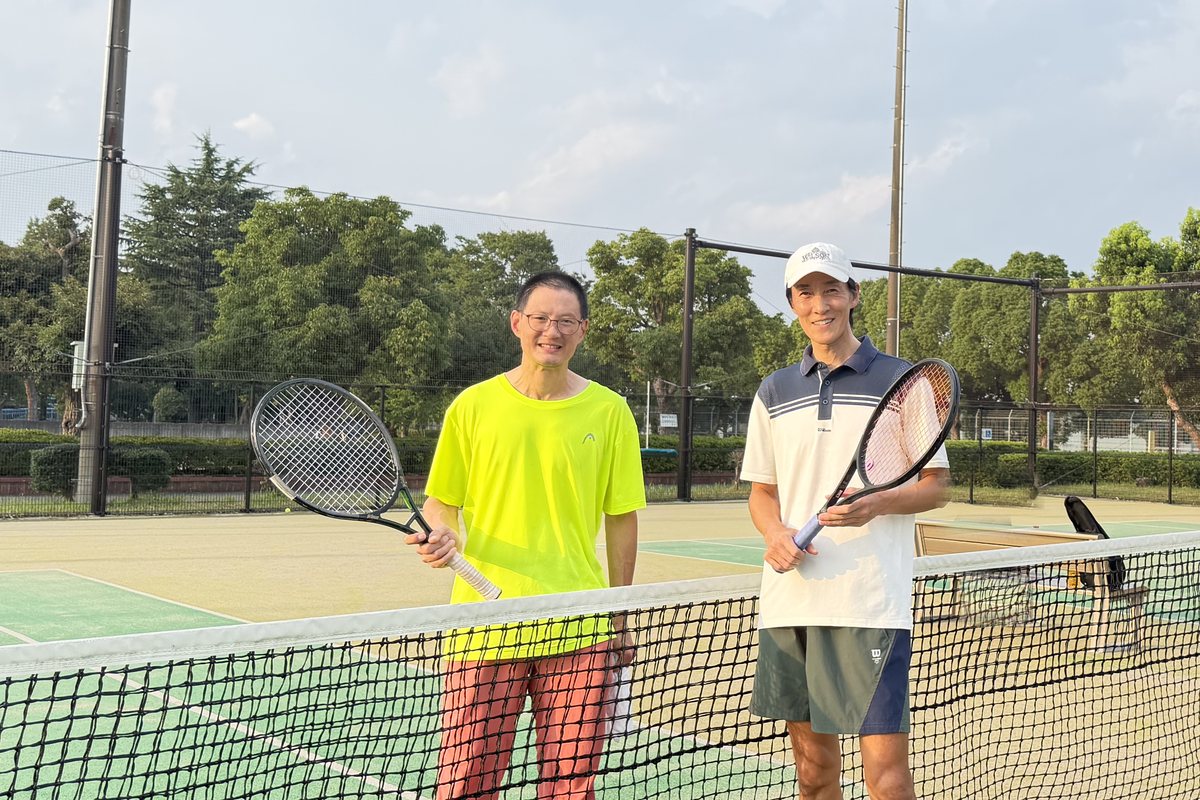
The two hosts of Green Set Tokyo standing at the net on an outdoor court, rackets in hand.
Our home court, on a summer evening in Tokyo's western suburbs.

Who you'll be playing with

If you book, we are the ones who turn up.

Every session is run by one or both of us in person — no rotating staff, no guide hired in for the day. We both play at NTRP 4.5, so unless you are a professional, there will be someone here who can play at your level. Sessions run for two hours and we work out what to do once we are on court; there is no fixed programme. If you have played for years and would rather just get on with it, we will not push ourselves into your game. It all runs in English — Tomoaki manages well enough, and Stuart grew up speaking it and takes over whenever the words matter.

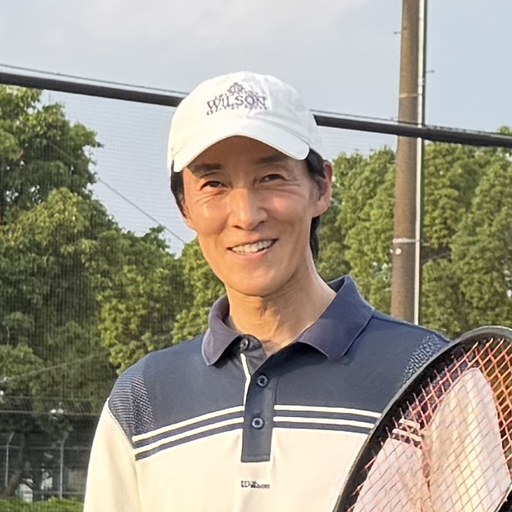
Tomoaki, founder of Green Set Tokyo.

Tomoaki

Founder & Host

I picked up a racket in high school and haven't put it down in nearly thirty years. I work in the tennis retail trade, which is how I noticed the problem: visitors kept telling me they wanted to play in Tokyo and couldn't work out how. Booking a court here means Japanese-only systems, resident-only lotteries and phone calls. Most people give up.

So I built the thing I wished existed. I know the courts in Tokyo's western suburbs about as well as anyone does, and I handle every booking myself — securing the court, meeting you on the day, and stepping on court when the numbers need evening out.

A word about my English: it is not beautiful, but everyday conversation is no trouble at all. It is enough to get us to the court, sort out your train ticket, order you the right bowl of soba and keep a conversation going for two hours. Now and then you may catch me reaching for an AI to find the word I am after — I hope you will forgive me. And when the tennis talk turns properly technical, I hand over to Stuart. He is the one who grew up speaking it.

I play from the baseline; groundstrokes are my game. I finished third in doubles and reached the quarter-finals in singles at the Meguro Ward championships here in central Tokyo. Which is a long way of saying I can keep a rally going as long as you want it to last.

NTRP 4.5 Baseline player Everyday English Hosts every session

Two hours of real tennis, somewhere green, with someone who knows the area — and a memory of Tokyo you couldn't have bought anywhere else. That's what I want to send you home with.
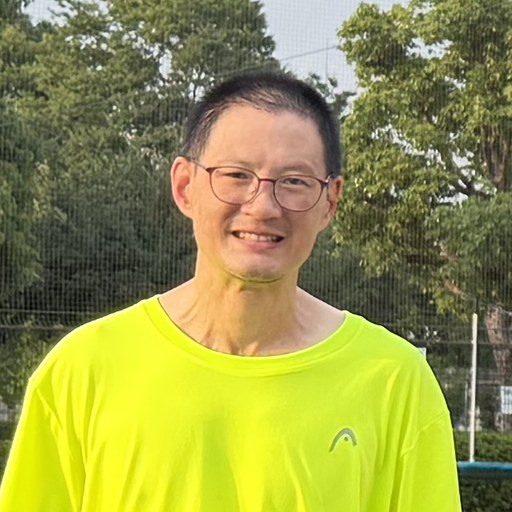
Stuart Lee, head coach at Green Set Tokyo.

Stuart Lee

Head Coach

I grew up in Hawaii with a racket in my hand and I have been playing for more than forty years. As a junior I got to 14th in the Hawaii state rankings in boys' 18-and-under singles, then played through my university years in Colorado.

I first came to Japan as a student in 1994 and moved here for good in 1999. Since then I have won municipal titles around western Tokyo — Fuchu (singles, doubles and team), Inagi (singles, doubles and mixed), Tachikawa (team) and Kunitachi (doubles) — and played for Fuchu at Tokyo metropolitan level. I also run a tennis and badminton equipment business from home, so I will have opinions about your grip size.

Then my right shoulder gave out. Rather than stop, I rebuilt my game left-handed. My serve is not what it used to be, I will admit that — my footwork will still make you earn the point. And when I teach someone who has never played, I am not guessing what starting from zero feels like. I have done it twice.

NTRP 4.5 Native English speaker PTR-certified coach 40+ years playing

I'm always looking for someone to hit with. Go easy on me.

How we work together

Four on court at most — the fewer of you, the more you hit.

Four per court, and it isn't a marketing line: four is exactly one doubles match, so nobody sits on a bench waiting for a turn. In a big group session you spend most of the hour in a queue and hit a few balls fed from a basket. Here you rally with a live ball, over and over — which is more fun, and happens to be what actually makes you better.

Tomoaki secures the court

Court availability in Tokyo shifts weekly. Tomoaki books it, checks the weather, and sends you directions that actually make sense in English.

We run the tennis

Warm-up, rallies, then games. Between us we have been reading the ball for a long time, so wherever you hit it, it comes back where you can reach it. Ask for pointers and you will get them — but the session is built around playing and enjoying it, not being taught.

We both play — when it helps

Odd numbers, mismatched levels, or you just want someone to rally with — one of us steps on court. Neither of us runs out of steam, in August heat or February cold. Hit it wherever you like. We'll get it back! But if you have four who can rally between yourselves, we are just as happy to hand you the court and wait courtside — or in the clubhouse — until you want us.

By the way

The sport itself seems to be rather good for you.

Not our field, and not something we are claiming — but since people ask why tennis, the research is hard to ignore. Researchers in Copenhagen followed 8,577 adults for up to 25 years and compared eight leisure sports against a sedentary life. Tennis came out on top, and not by a little.

9.7extra years

Extra years of life expectancy, against doing no sport at all

The researchers' own explanation is the interesting part: the sports at the top of the list are the ones you cannot do alone. They put the social side of it — a regular partner, a standing appointment, people who notice when you don't turn up — down as a large part of the difference.

Extra years of life expectancy vs. a sedentary life
  • Tennis9.7
  • Badminton6.2
  • Soccer4.7
  • Cycling3.7
  • Swimming3.4
  • Jogging3.2
  • Calisthenics3.1
  • Health club1.5

Two larger studies since have pointed the same way. In a British cohort of 80,306 adults, racquet-sport players were the least likely of any group to die during the study. Among 272,550 Americans aged 59 to 82, racquet sports again came first out of seven activities — which is to say it is not too late to start in your sixties.

Schnohr et al., Mayo Clinic Proceedings, 2018 · study — Oja et al., British Journal of Sports Medicine, 2017 · study — Watts et al., JAMA Network Open, 2022 · study

All three are observational: they show that people who play racquet sports tend to live longer, not that the tennis is what did it. A good excuse for two hours on court, then — not a promise from us.

Come hit with us.

Play a real match. Rally for the fun of it. Or pick up a racket for the very first time. Tell us which — and your dates — and we'll build the session around it.

Book a Session

Nothing is charged until your court and date are confirmed.